

Should Your Business Elect S Corporation Status? Tax Savings, Risks, and When It Makes Sense
Should your business elect S corporation status? Learn how reasonable compensation, Section 199A, accountable plans, shareholder basis, health insurance, state taxes, and distribution rules determine whether the election creates real savings.

Schedule C or Form 1065? How Husband and Wife LLC Owners Should Choose
Should a husband and wife LLC file Schedule C or Form 1065? Learn how community property rules affect eligibility and compare the filing costs, self employment tax treatment, deadlines, and state requirements of each option.

Do You Use a Personal Credit Card for Business Expenses? Read This Tax Court Case First.
A recent Tax Court case denied a $16,901 interest deduction because the business owners could not prove the debt belonged to the business or adequately document the underlying transactions. Learn how to avoid the same mistake.

Can The IRS Disallow A Tax Strategy That Follows The Tax Code?
A recent federal court decision denied more than $100 million of claimed tax benefits because the underlying transaction lacked economic substance. Learn what business owners should know before implementing sophisticated tax planning strategies.

Received a Form 1099 After Filing? What to Do Next
A late Form 1099 does not automatically mean additional tax is due. Learn what to review after receiving a Form 1099 after filing, how IRC Section 6201(d) applies to disputed information returns, and what changes if the IRS sends a CP2000 notice.

The Overlooked Tax Free Employee Benefit: Educational Assistance Plans and Student Loan Repayment
Most employers have never heard of Educational Assistance Plans. Learn how your business can provide up to $5,250 annually in tax free education and student loan repayment benefits while receiving a tax deduction.

IRS Warns Side Hustle Owners: Hobby Income Is Still Taxable
The IRS recently reminded taxpayers that hobby income is taxable even when an activity is not operated as a business. Learn how hobby income is reported, why Forms 1099-K and 1099-DA matter, and how the IRS distinguishes a hobby from a business under IRC Section 183.

Employee vs. Independent Contractor: How to Avoid Costly Worker Classification Mistakes
Worker misclassification is one of the most expensive tax mistakes a business can make. Learn how the IRS determines whether a worker is an employee or independent contractor and how to avoid payroll tax penalties, audits, and compliance issues.

Mortgage Interest Deduction Rules: Lessons From a Recent Tax Court Case
A recent Tax Court case highlights the strict requirements for claiming the mortgage interest deduction. Learn when mortgage interest is deductible, why documentation matters, and how homeowners can avoid costly IRS challenges.

Cryptocurrency Staking Rewards Are Taxable Upon Receipt: What the Paschall Case Means for Investors
The Tax Court has now confirmed that cryptocurrency staking rewards are taxable income when received, not when sold. Learn how the Paschall case affects crypto investors, the IRS position on staking rewards, and what records you should maintain to avoid costly tax reporting mistakes.

How to Document Profit Motive for an IRS Hobby Loss Audit
Good records can be the difference between winning and losing an IRS hobby loss audit. Learn which documents impressed the Tax Court, how successful taxpayers proved profit motive, and the records every business owner should maintain under IRC Section 183.

How to Win an IRS Hobby Loss Audit: Lessons from Tax Court Cases
The IRS can deny business deductions if it determines an activity is a hobby rather than a business. Learn how taxpayers won and lost real Tax Court cases, what records impressed the court, and the mistakes that destroyed otherwise valid deductions under IRC Section 183.
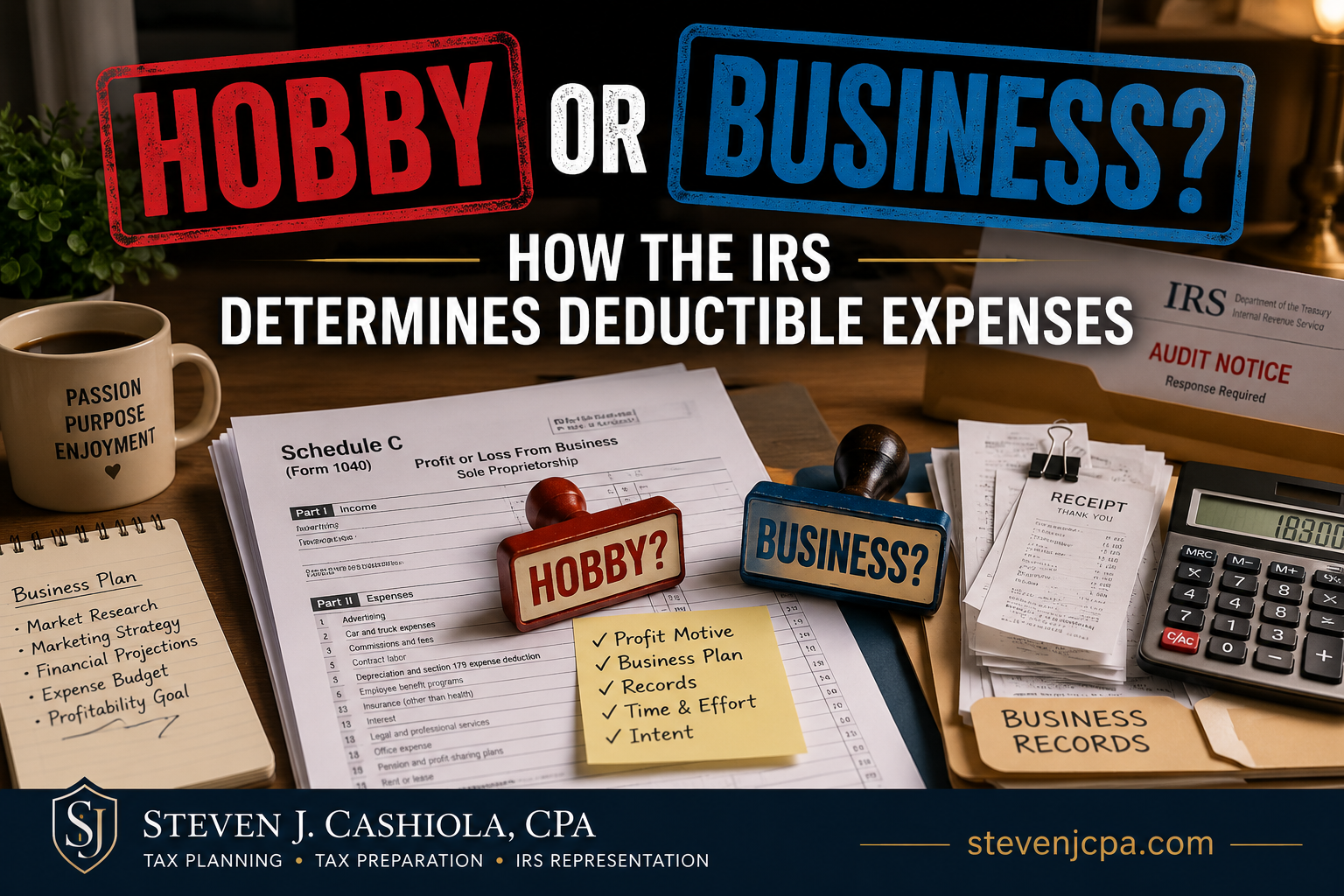
Hobby vs Business Tax Rules: How the IRS Determines Deductible Expenses
If your business, side hustle, farm, rental activity, or passion project generates losses, the IRS may challenge your deductions. Learn the hobby loss rules, the profit motive factors, and the steps taxpayers can take to protect valuable tax benefits.

Trump Accounts: A New Way to Build Wealth for Your Children
Learn how Trump Accounts work, who qualifies for the $1,000 Treasury contribution, and why parents and grandparents may want to open one for a child even without the government match.

Selling a C Corporation With Appreciated Assets Can Trigger Catastrophic Tax Liability
A new Federal Circuit case shows how selling appreciated assets inside a C corporation can trigger massive transferee liability, penalties, and interest. Learn the tax risks business owners need to understand.

New $1,000 Federal Retirement Match for Self Employed and Small Business Owners
Self employed taxpayers and small business owners may qualify for a new $1,000 federal retirement match through qualifying IRA contributions under SECURE 2.0 and TrumpIRA.gov.

IRS Cracking Down on Conservation Easement Tax Deductions: What Landowners and Investors Need to Know
The IRS continues aggressive audits of conservation easement tax deductions and syndicated easement deals. Learn how recent Tax Court losses, inflated appraisals, and 40% penalties are affecting landowners and investors.

IRS Data Reveals Where High Income Taxpayers Pay the Most Tax (2026 Update)
IRS 2026 filing season data shows where high income taxpayers pay the most tax and where the IRS is focusing audits. Learn key planning opportunities and risks.

New Tax Deduction for Tip Income: Who Qualifies and How Much You Can Deduct
Service workers may qualify for a new tax deduction on tip income. Learn who qualifies, what counts as tips, eligible professions, and how to maximize your deduction under current IRS rules.

The Tax Traps of Life Insurance Contracts
Life insurance policy loans can create unexpected taxable income when policies lapse. Learn the risks, Tax Court guidance, and how to avoid costly tax surprises.